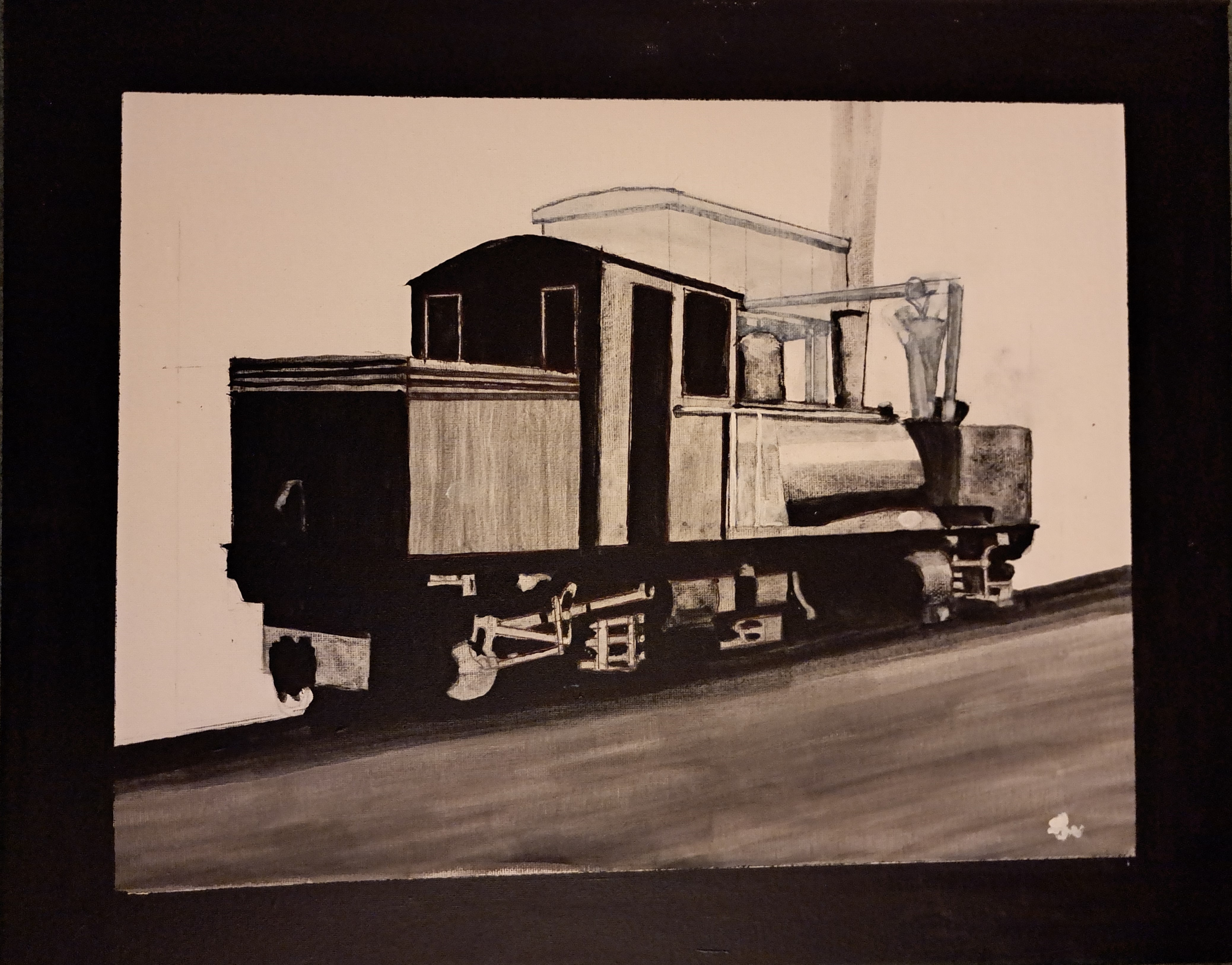
STEAM FAVOURITE
Size 50×40
Acrylic on canvas. Painted border.
Date 2025
Suggested minimum price £60
The Beyer Peacock K1 locomotive.
Built in 1909 to H. W. Garratt’s patent, the first of over 1000 Garratt type articulated locomotives exported from Manchester to all corners of the world.
They gave reliable service in some of the most remote places on Earth.
K1 is one of the most significant preserved Australian steam locomotives, as it and sister K2 were the first in the world built to the Beyer-Garratt articulated locomotive design. Beyer-Garratt locomotives took their name from the patented designs of Herbert William Garratt and were built by (or under subcontract to) Beyer Peacock & Company of Manchester. This significant innovation in locomotive design delivered a large, efficient boiler and deep firebox slung between two bogie power units, providing the tractive effort of two locomotives without the cost of two crews. Articulation made the Beyer-Garratt well suited to tight curves, and coupled with their high tractive effort, the Beyer-Garratt design came to be associated with steep and curvaceous railway routes.
K1 was built by Beyer Peacock & Co (builder’s number 5292 of 1909) a for the Tasmanian Government Railway’s North East Dundas Tramway from Zeehan to Williamsford on Tasmania’s west coast. K1 and K2 had a 0-4-0 + 0-4-0 wheel configuration, providing good flexibility around the tight curves of the North East Dundas Tramway. K1 and K2 used a compound steam expansion system which was not repeated on subsequent Garratt locomotives, with the rear bogie using high pressure steam and the leading bogie further expanding the steam in larger diameter low-pressure cylinders. a The cylinder positioning on the inside of the bogie was also not repeated on later Garratt locomotives, as this placement led to a hot cab floor.
Fortunately K1 was saved for preservation as early as 1947 when it was repurchased by Beyer Peacock & Co for display at its Gorton workshops in Manchester. a The preserved K1 contains some components of sister K2, and was apparently rebuilt with some K2 components after lying in storage at Zeehan, Tasmania since about 1939.
K1 was sold to the Ffestiniog Railway in 1966 after closure of Beyer Peacock & Co. It was subsequently displayed at the National Railway Museum, York during from the 1980’s to 1995.
Since 1995, K1 has been fully overhauled and restored to operation by the “K1 Group” for use on the Welsh Highland Railway, including the construction of a new boiler. Here it complements a fleet of more modern Beyer-Garratt locomotives in the form of ex-South African Railways NGG16-class 2-6-2 + 2-6-2 locomotives.
 Dorset Artist